In this article
Yes. Organic social media is worth it for every small business. The real question is how much of it your business needs.
Your customers look you up before they get in touch. In IAB Australia's 2026 Commerce & Discovery report, 68% of Australian online shoppers said they use social media to discover, research or compare products and brands. Among 18- to 39-year-olds, that rises to 88%. When they find you, your profiles show them a business that's open and busy, or a page that went quiet two years ago.
Some businesses only need to keep the lights on: a few posts a fortnight that show you're open, current and real. Others want social to bring in new customers, and that takes more posts, a plan and ideally someone on camera. Most sit somewhere in between. Below, we cover what organic social does for a service business, how much to post, which platforms to use and where paid ads fit.
We wrote this for owner-run service businesses in Australia: service-based or bricks-and-mortar businesses. If you run an online store, most of it still applies, but you're playing a slightly different game, and we cover that further down.
Your posts now work outside social
Your social posts used to stay inside the apps. Since July 2025, Google and other search engines can index public posts from Instagram business and creator accounts. Your reels, carousels and captions can now show up when someone searches for your business, or for the service you offer, without ever opening Instagram.
AI answers learn the same way. Peec AI analysed 30 million sources cited by AI search tools in the US in March 2026. YouTube, Reddit, Facebook and LinkedIn were the most-cited sources in both Google's AI Overviews and AI Mode, so Google's AI is pulling heavily from the platforms you already post on.
This space changes month to month, so we won't claim more than the data shows, and what it shows is that every public post on a business account becomes one more place Google and AI tools can find you.
Why it feels like a waste of time
Most owners who tell us organic social doesn't work have already tried it, and their story usually goes the same way. They decide to take social seriously and post every few days for a month. Then a big job lands, life gets busy, and the account goes quiet for the next six months. Looking back, they've sunk hours into content and can't point to a single enquiry it brought in.
That frustration is fair. In our experience, the cause sits upstream of the posting: no plan and no simple content strategy. Without one, every post starts from a blank page, each post takes far longer than it should, and the first busy week breaks the habit.
The same few mistakes show up in most accounts we audit:
- Posting in bursts: A month of activity followed by silence tells your followers, and the platforms, that you're unreliable. A steady three posts a week does more than twenty posts in March and nothing until September.
- Starting from scratch every time: With no pillars, no set formats and no batching, every post turns into a creative project and eats half your afternoon.
- Chasing likes over enquiries: Likes feel good, but they don't pay the bills. Judge your account on DMs, calls, website clicks and customers who mention they saw you online.
- Stopping before it compounds: Organic social builds slowly. An owner who stops after two months never finds out what month six would have looked like.
Posting that does more harm than silence
Being active only helps if what you post makes you look good. A blurry photo of a half-finished job, a stock image with a generic caption or a comment left unanswered for a week all tell a browsing customer something about you, and so does a profile still promoting a Christmas special from three years ago. Sloppy AI use does the same damage: captions that read like every other business's, AI images with warped hands or garbled signage, and canned replies to comments tell people nobody real is behind the account. Use AI to help you plan and draft, then make sure the finished post sounds like you and shows your actual work.
A simple content strategy
Keep the plan simple enough to survive a busy month. For most service businesses, a content strategy may look like:
- Three content pillars: the topics you keep coming back to, such as your work, your team and the questions customers ask you.
- Two or three repeatable formats: a before-and-after carousel, a short process reel, a video answering a common question. Use the same structure every time.
- A set rhythm: pick your posting tier (more on that below) and lock the days into your calendar.
- One batch session a month: shoot and write a month of content in one sitting, then schedule it.
- Capture as you work: keep your phone handy on jobs so you never run short of footage when the batch session comes around.
- A monthly check-in: look at which posts brought in DMs, calls or clicks, and make more of those.
What organic social does for a service business
Done well, organic social makes you the business people trust before they've ever spoken to you. It does that in three main ways, with a couple of useful side benefits.
Your digital shopfront
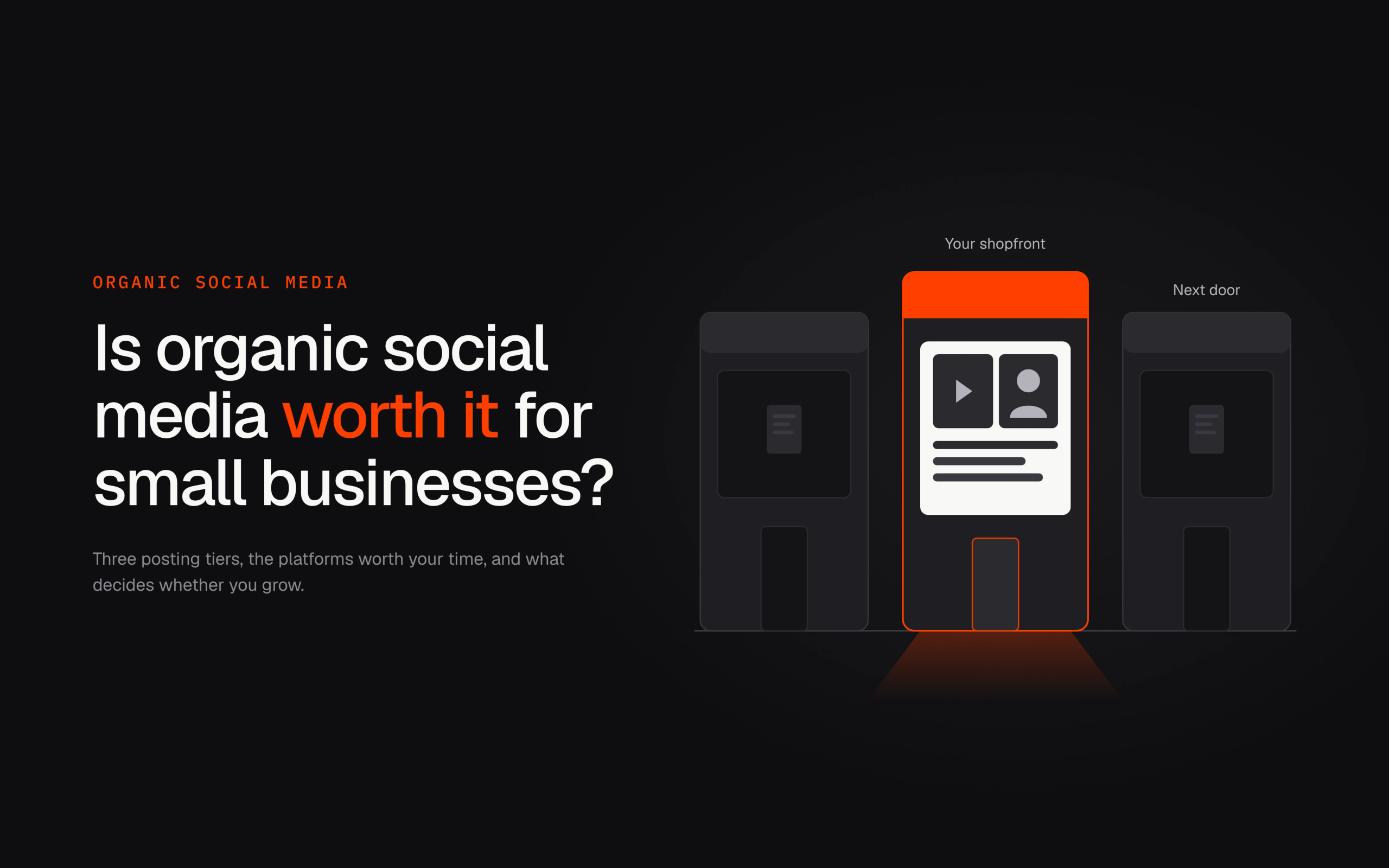
Think of your social profiles as a shopfront on a digital shopping centre. Nearly every customer now window shops online before they buy, scrolling past you and your competitors on the same strip. When your social is done right, your lights are on. The window shows your work, the people behind it and why someone should pick you. The shop next door, offering the same service, has its lights off and a catalogue taped to the glass. Most people walking past are only browsing. When one of them is ready to buy, they remember which window was lit.
In marketing terms, social sits at the top of the funnel. Most people who see your posts are browsing and won't need you this week. Your social has one job with them: make you the trusted choice on the day a browser turns into a buyer.
Trust before the call
I grew up with social media. To my generation, a business's Instagram carries the same weight as its website.
The data backs that up. In Oysterly Media's survey of 1,200 Australians in early 2026, only 26% of Gen Z said they start product research on Google, and 42% of young Australians said they go to a brand's social profile to make their final decision. The same survey found more than eight in ten Australians cross-check information before they buy, because fake reviews, sponsored posts and AI-generated content have made people sceptical of anything that looks like an ad.
Trust takes more work to earn than it used to. Social lets you earn it before the first phone call, by showing the work and the people who do it.
Top of mind
Most service businesses sell something people buy once every few years: a new dentist, a bathroom renovation, a ceramic coating. Regular posts keep your name in front of past customers and the people they know. When the need comes up, or a mate asks for a recommendation, you're the name they think of.
Proof of work
Every job you post adds to a running portfolio. A prospect can scroll back through months of finished work before they ring, and it answers most of the questions they'd otherwise ask on the phone.
The side benefits
- An audience you own: The platform decides who sees each post, so your followers are rented. Move them onto an email list and you can reach them whenever you like. We cover how in our guide to organic social media for car dealerships.
- Content that feeds everything else: The same photos and videos end up on your website, your Google Business Profile and in your ads. Shoot once and use it everywhere.
If you run an online store
E-commerce plays a slightly different game. Social can sell directly through product tags, in-app shops and links straight to checkout, so online stores lean harder on volume, short-form video and paid ads than a local service business. The shopfront and trust principles still apply, and you'll likely sit higher in the posting tiers below.
How much you need to post
Pick the tier that matches what you want from social. For most service businesses, three posts a week gives the best return for the time it takes.
Proof of life: one or two posts a fortnight
This tier suits businesses where customers only need to see that you're open, current and legitimate before they call. It also suits a team or workplace that doesn't lend itself to being on camera. Don't expect growth from it. Expect profiles that look alive and accurate when someone checks you out.
We manage the marketing for a Brisbane metal fabrication business. The staff and leadership didn't want to be on camera, and they didn't want to do social at all because of the nature of their work. We insisted on proof of life. We post once or twice a fortnight across Facebook, Instagram, LinkedIn and their Google Business Profile, so every profile stays consistent, accurate and current whenever someone looks them up. They get the benefits of being alive on those platforms without spending any energy on growing them.
The sweet spot: three posts a week
Three posts a week gives the best value for the least time and effort. It's enough to keep your portfolio growing, keep you top of mind and give the platforms enough content to push you to new people. With a monthly batch session, plan on two to four hours a week if you do it yourself.
Growth: every day
Daily posting is for owners who want social to become a lead channel in its own right. Every post is another chance for the platforms to show you to people who've never heard of you, so reach grows much faster. It also takes a real content plan, someone on camera and usually help with production. We come back to what this looks like for one of our clients in the platforms section.
Doing it yourself or handing it off
Most owners can run proof of life themselves with one batch session a month. The sweet spot is manageable on your own with a plan, as long as you protect the time. Growth usually needs help, whether that's a team member, a freelancer or an agency, so the posting survives your busy months. Whoever runs it, the owner still needs to appear in some of the content.
Whichever tier you choose, you get the passive benefits of being active on social, as long as you post regularly and nothing you post hurts your reputation. How far you grow beyond that comes down to the next section.
What decides whether you grow
Posting keeps you alive on social. Growth comes down to four things, and the biggest one is whether people can see who's behind the business.
Get the owner and team on camera
The businesses we've seen grow fastest have the owner or their operators on camera. They show the process, show the finished work and tell the story of the business as it unfolds. People buy from people they feel they know, and social builds that connection before the first conversation in a way no other channel can. As buyers grow more sceptical of polished advertising, that human connection matters to a bigger share of your prospects every year.
A phone and a job in progress is enough to start. Film a step of the process, explain a call you made on site, or answer a question a customer asked you that morning. How far you can take this depends on your team and your workspace. Some businesses suit the camera better than others, and that's why the proof of life tier exists.
Content people stop for
The platforms show your posts to more people when viewers stop, watch, save and share them. Posts that teach something, show a transformation or take people behind the scenes earn that attention. A logo with "Call us today" underneath rarely does.
A strategy behind the posts
Pillars, formats and a set rhythm, like the simple plan above, turn scattered posts into a body of work. They also show you what's working, so each month improves on the last.
Consistency
The accounts that grow are still posting in month nine, at the same standard, through the busy months. That takes management as much as content: someone has to own the calendar, reply to comments and DMs, and keep it running when work gets hectic.
How tightly you control your brand's image plays a part too. A business happy to post raw, fast content can post far more often than one where every post needs polishing, so set your tier with that in mind.
Which platforms to use
Instagram and Facebook are the core for most service businesses, but your customers spend time on more platforms than those two.
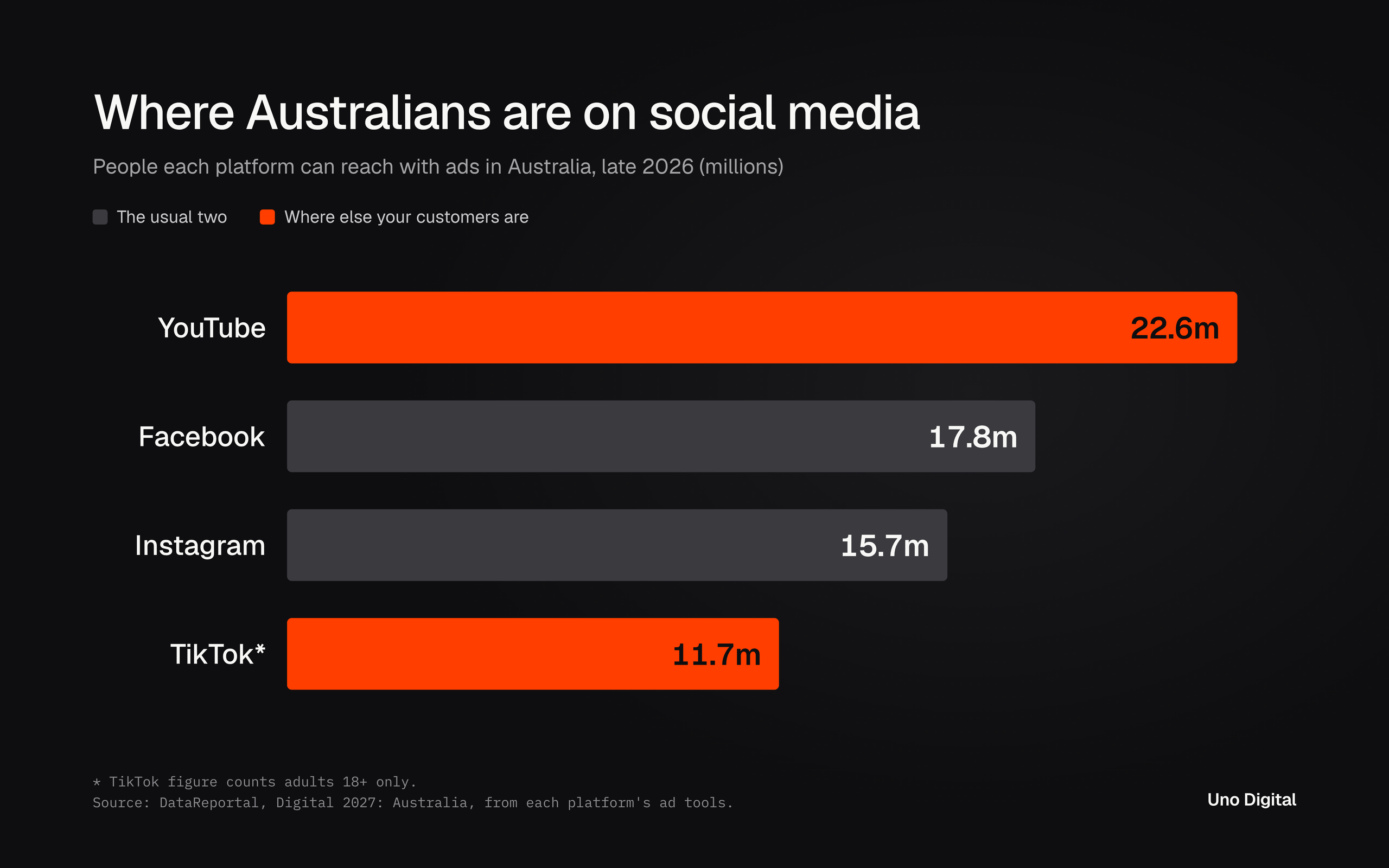
Source: DataReportal, Digital 2027: Australia, late 2026 figures from each platform's own ad tools. TikTok counts adults only.
Meta (Instagram and Facebook)
Build your content for these two first. Instagram suits the visual, behind-the-scenes content that sells a service. Facebook still reaches 82.5% of Australian adults, according to DataReportal, and its local and community groups matter for local businesses.
TikTok
TikTok is here to stay. Its adult audience in Australia grew 7.6% in a year to 11.7 million. If you already make vertical video for Instagram, posting it to TikTok costs you minutes.
We ran that exact test for Detail Theory, a car care store in Cleveland. We made all their content with Instagram in mind on a daily schedule, then copied each post to TikTok as a trial, which added about five minutes per post. Within nine months, their TikTok had close to a million post views and 22,000 likes. The owner started getting walk-ins who'd found the shop on TikTok, and a surprising share of them weren't who you'd picture as TikTok users.
YouTube and Shorts
YouTube has the biggest reach of any platform in Australia, at 22.6 million people by Google's own ad figures. Shorts lets you post the same vertical videos there at no extra cost, and YouTube is the most-cited source in Google's AI Overviews in Peec's research.
An opening on YouTube
Long-form YouTube is the biggest gap we see for Australian small businesses. QUT's Australian Media Uses Report 2026 found 88% of Australians have never posted a video to YouTube, and viewers rate information videos, such as how-tos, tutorials and explainers, as the type that matters most to them. Yet we see very little YouTube content from Australian businesses answering their own customers' questions. A business that starts filming those answers now has the field mostly to itself.
LinkedIn works for particular businesses right now, mostly B2B services and owners building a personal brand. If your customers are other businesses, it belongs in your mix. If they're households, keeping it at proof of life is enough.
Make each piece of content once, built for Instagram, then cross-post it to Facebook, TikTok and YouTube Shorts. Each platform puts the same video in front of a different crowd, and skipping them wastes content you've already paid to make.
Organic and paid: two tools, two jobs
Organic social and paid ads do different jobs, and most growing businesses end up using both. Organic builds trust and shows you which content your audience responds to. Paid takes the posts that have already proven themselves and puts them in front of more of the right people, faster.
The order matters. Ads pointing to a profile with no recent posts send paying traffic to a shopfront with its lights off. Build the organic foundation first, learn what works, then put money behind the winners. When someone clicks your ad, they land on a profile that shows them exactly who you are, and that profile does a lot of the convincing for you.
FAQ
How often should a small business post on social media?
Three times a week is the sweet spot for most service businesses. If you only need to show you're open and current, one or two posts a fortnight is enough. Post every day if you want social to become a lead channel.
Is organic or paid social better for a small business?
They do different jobs. Organic builds trust and shows you which content works, and paid scales the posts that already work. Start with organic, then add paid once you know what your audience responds to.
Which social media platform is best for small businesses in Australia?
Instagram and Facebook, for most service businesses. Cross-post the same vertical videos to TikTok and YouTube Shorts for extra reach at almost no extra cost, and add LinkedIn if you sell to other businesses.
How long does organic social media take to work?
Expect three to six months of consistent posting before it shows up in enquiries. The passive benefits, like looking active and trustworthy when people check you out, start as soon as your profiles are current.
Turn your lights on
Every small business gets something from organic social. What's left to decide is which tier fits yours, and whether your profiles show a lit window when a browser walks past.
If you'd like a second opinion, get in touch. We'll run a free audit of your social profiles and show you where the gaps are. To see an organic strategy in practice first, read our case study on The Stable, a Brisbane Porsche and Ferrari dealership where organic content became the core marketing channel.

Ethan Prestidge
Co-founder
Ethan started his first business at 18, grew it to six figures in recurring revenue and sold it in 2024. Building an audience for it led him into photography, video and creative made to sell. At Uno, he leads content and client relationships.
- Organic Strategy
- Photography & Videography
- Social Media
- Design